
Earth-Flagged on Mars: Analog Astronautics and the Symbol of a Shared Home
In a sun-baked canyon landscape outside Hanksville, Utah, a figure in a simulated spacesuit pauses to hold up something small but striking: a patch bearing the iconic “Blue Marble” image of Earth. It’s a quiet moment, but it carries a world’s worth of meaning (quite literally!).
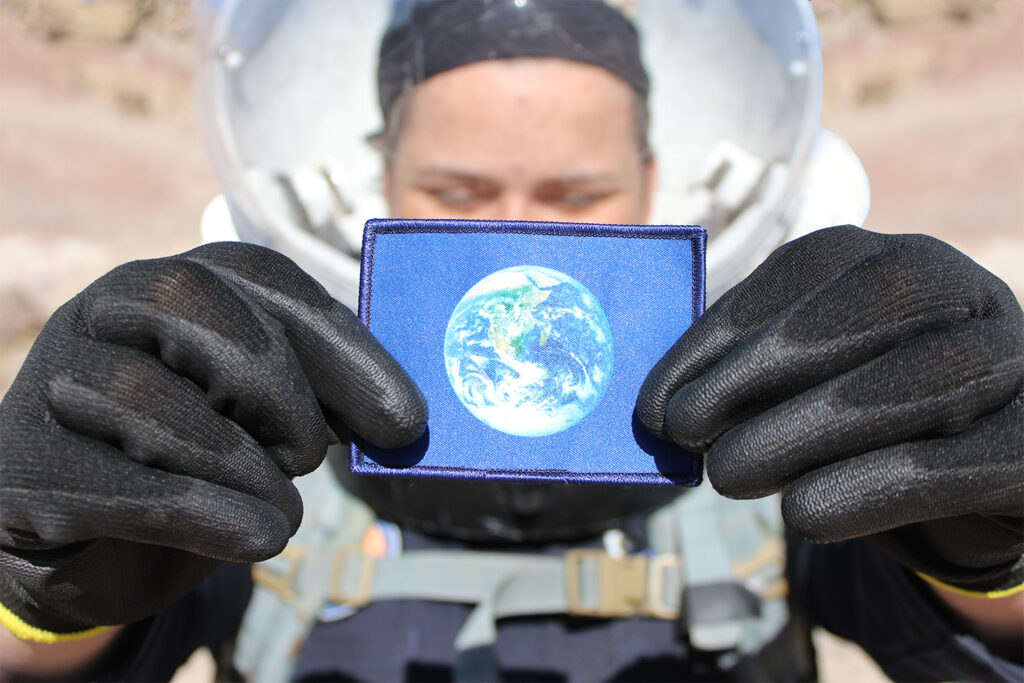
The location is the Mars Desert Research Station (MDRS), operated by the Mars Society in one of the most Mars-like environments on Earth.
The red rock terrain of the Utah desert, sculpted by the same forces of wind and erosion that shape the Martian surface, provides an ideal backdrop for testing the science, technology, and human dynamics that future Mars explorers will depend on. Crews live in close quarters inside a habitat module, operating under resource constraints and communication delays that mirror the realities of deep space. When they venture outside they do so in simulated spacesuits going through a simulated airlock and simulating the work of astronauts on Mars: practicing the fieldwork protocols, geology surveys, and equipment tests that could one day be standard procedure on another world.

This is the work of analog astronautics: rehearsing humanity’s future by simulating it on Earth. Long before anyone sets foot on Mars, scientists and engineers need to understand how people perform under pressure, how systems behave in harsh environments, and how knowledge gets built in the field when resources are scarce and the margin for error is slim. MDRS has been that proving ground for decades, hosting crew rotations that produce real scientific data while sharpening the operational lessons that will make crewed Mars missions safer and more effective.
But MDRS is not the only analog habitat. There are now dozens of these analog stations at various sites around the world. They provide means for people to explore what life might one day be like on the Red Planet and other worlds.
But there’s something else in this image worth looking at: the patch itself.
The Earth flag — a deep blue field centered on the Blue Marble photograph taken by Apollo 17 astronauts in 1972 — is the symbol championed by One Flag in Space, an initiative of Blue Marble Space. The mission is beautifully straightforward: to promote the Earth flag as a unifying symbol for space exploration. No national borders. No competing allegiances. Just the planet, whole and radiant, suspended in the dark.
One Flag in Space collects photographs of the Earth flag from locations around the world — from Antarctica to the Himalayas, from the International Space Station to the streets of dozens of cities on every inhabited continent — as a growing visual argument that space exploration belongs to all of humanity. When an analog astronaut at MDRS holds that flag up to the Utah sky while wearing a simulated spacesuit, the image brings the argument into sharp focus. Here is a person practicing for a journey that no single nation will take alone, holding a symbol that says as much.
There is something fitting about the Earth flag appearing in an analog mission context. The whole premise of analog astronautics is perspective: the practice of stepping outside the ordinary and asking what it would feel like to look back at Earth from somewhere profoundly far away. When future explorers stand on the Martian surface and look up to find Earth as nothing more than a pale blue dot in the sky, the boundaries that define our nations will not be visible from there. What will be visible is the planet itself: one world, shared by everyone who has ever lived on it and maybe even in the future for those who only know it as our original homeworld.
The Earth flag, displayed here in the red desert of Utah by someone training for that very future, captures that perspective.
You can learn more about One Flag in Space and submit your own Earth flag photos at oneflaginspace.org.