
EarthFlagged at the Kāpehu Whetū — Tauranga’s Celestial Compass
Standing in a flat green field near the harbor at Sulphur Point in Tauranga, Aotearoa, New Zealand, a ring of white wooden posts reaches toward the sky. At first glance, the installation might seem like public art — and it is, in part — but each post carries a precise purpose rooted in thousands of years of human ingenuity.
This is the Kāpehu Whetū, the Celestial Compass, and it recently became home to an #EarthFlagged moment, as BMS founder and CEO, Dr. Sanjoy Som, held our One Flag in Space Earth flag by the posts.
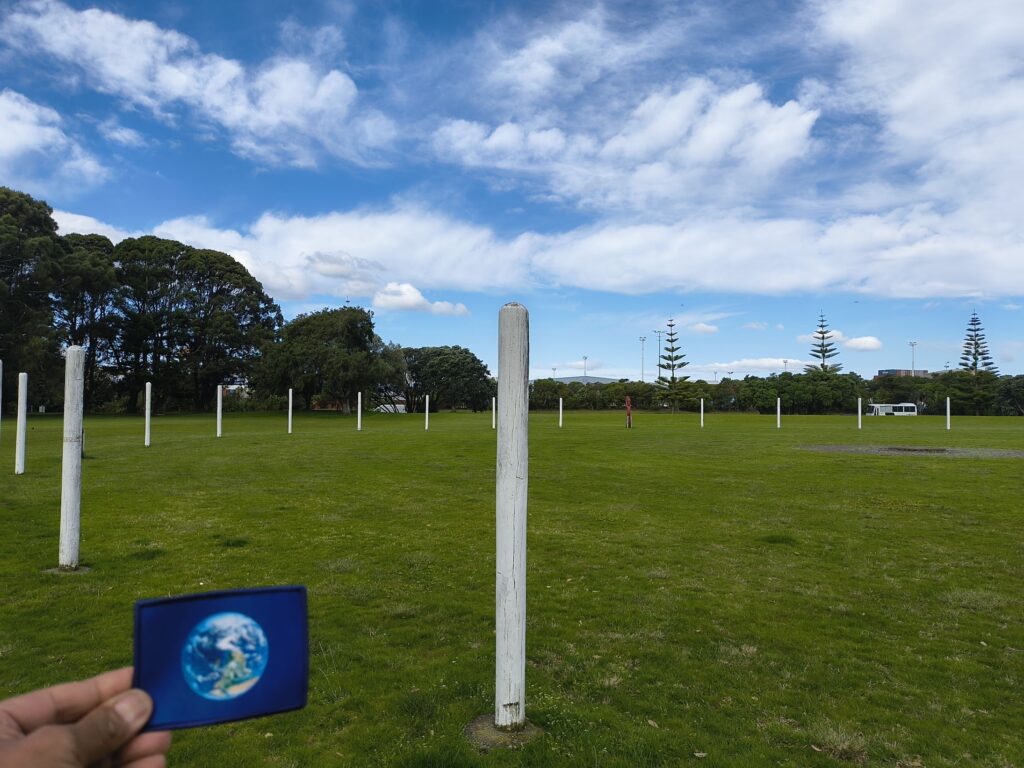
The compass was established in 2005 by Jack Thatcher, one of Aotearoa New Zealand’s most celebrated celestial navigators, making it the second such installation in the country. The structure at Tauranga has four main poupou — carved posts — oriented to face north, south, east, and west, with additional plain posts between them representing the 28 Polynesian “houses” of the full horizon. These houses aren’t arbitrary divisions; they are defined by the rising and setting positions of celestial bodies — stars, the Sun, the Moon — as observed from the open ocean. Thatcher initially aligned the posts using a conventional compass, then returned after dark to verify them using traditional techniques alone. The posts lined up perfectly.
That precision speaks to the depth of the navigational tradition the Kāpehu Whetū honors. For thousands of years, Pacific peoples crossed the world’s largest ocean in double-hulled voyaging canoes (waka hourua), guided not by instruments but by an intimate, embodied knowledge of the sky, sea, and wind. A navigator trained in this tradition needed to know the positions of at least 220 stars, according to the Society of Māori Astronomy Research and Traditions (SMART). Beyond the stars, voyagers read ocean swells rolling in from distant weather systems, watched for the behavior of seabirds flying toward land, and interpreted cloud formations above unseen islands. This was not guesswork — it was a sophisticated, rigorous system developed and refined across generations of open-ocean experience, encoded in oral traditions and passed from teacher to student across the Pacific.
Much of that knowledge was disrupted during the colonial period, when traditional voyaging practices declined sharply and the oral transmission chains that carried astronomical and navigational lore were broken in many communities. The revival began in the 1970s, led initially by Hawaiian navigators — most famously Mau Piailug of Satawal and Nainoa Thompson of the Polynesian Voyaging Society — who undertook voyages across the Pacific to demonstrate that the old methods still worked. The movement reached Aotearoa in earnest in the 1990s through the work of master navigator Sir Hector Busby (Pūhipi), who built the voyaging waka Te Aurere and was instrumental in reviving traditional navigation knowledge in New Zealand. Jack Thatcher carried that lineage forward, learning from Hawaiian master navigators and eventually serving as chief navigator during the Waka Tapu voyage to Rapa Nui and back in 2012–13 — a round trip of thousands of kilometres navigated using traditional techniques alone.
The Kāpehu Whetū at Sulphur Point is both a monument to that tradition and a living teaching tool, a place where Thatcher has continued to share wayfinding techniques with aspiring waka voyagers. The compass represents the entirety of a navigator’s environment — the stars overhead, the horizon all around, and the relationship between them that tells a voyager exactly where they are on the face of the ocean.
For One Flag in Space, the resonance runs deep. Our mission centers on the idea of Earth as a single home — and few things express that idea more powerfully than the knowledge that human beings, with no instruments beyond their own senses and memory, once navigated this entire planet’s oceans. The star compass is a reminder that the drive to explore, to find what lies beyond the horizon, is one of humanity’s oldest and most defining impulses. Celestial observation has always been central to how we move through the world — and, one day soon, beyond it.
If you’d like to share your own images of the Earth flag at locations around the world, check out One Flag in Space for more info.